The world population on Jan.1, 2024 was projected as 8.01 Billion an increase of 75.16 million from 1st Jan 2023(1✔).
Medindia’s world population clock displays simulated real-time growth of the world population. This is based on the calculation of a birth rate of 4.3 and a death rate of 2.0 every second. The current crude birth rate of the world is 18.5 per 1000 population and the death rate is 7.8 per 1000 population(2✔).
The world population in the last 200 years has grown rapidly at an exponential rate. It took the world 200,000 years to reach the one billion mark but it only took 200 years to hit the eight billion mark(3✔). The one billion mark was reached around 1804 and in just over 100 years (1927) the population had reached the 2 billion mark. After this, the population growth was even faster and it just took 12 years to jump from 6 to 7 billion ( from 1999 to 2011) and 11 years to cross from 7 to 8 billion (15th Nov 2022) (5✔).Paul Ehrlich said that there are only two kinds of solutions to the population problem - “One is a ‘birth rate solution,’ in which we find ways to lower the birth rate. The other is a ‘death rate solution,’ in which ways to raise the death rate — war, famine, pestilence — find us.”
Our earth is about 4.55 billion years old with a total surface area of 510.072 million sq km of which 148.94 million sq km is land and 361.132 million sq.km (almost 70%) of the surface is covered with water. It has limited resources and a fragile environment. The human population explosion and the exploitation of earth’s resource in the last 200 years has resulted in rapid depletion of its resources and is causing global warming.
Currently every year 83 million people are added but only 60 to 61 million people die. At this rate, we will double the world population every 50 to 60 years or even sooner.
“The problem is that the population is growing the fastest and people are less able to deal with it. So it’s in the very poorest places that you’re going to have a tripling in population by 2050. And we’ve got to make sure that we help out with the tools now so that they don’t have an impossible situation later.” - Bill Gates
In the human existence for the last 52,000 years on this planet, there have been a total of about 106 billion people. By 2037 we are likely to reach around 9 billion. British Physicist, J. H. Fremlin estimated this alarming rise and predicted our current growth as follows.
'At the current rate it would take only about 50 years to populate Venus, Mercury, Mars, the moon, and the moons of Jupiter and Saturn to same population density as Earth. . . It would take only about 200 years to fill [the remaining planets] "Earth-full." . . . What then? .' - J. H. Fremlin
World Population – Growth Chart
The growth of the world population from one billion in 1830 to 10 billion in 2058(14✔,(15✔)
Year
Population in Billion
1820
1
1930
2
1960
3
1974
4
1988
5
2000
6
2010
7
2023
8
2037
9
2058
10
Data reflects that in more developed a countries the population growth has slowed down or becoming negative and countries that are developing and has poverty have higher population growth.
The human form started from 190,000 B.C.E with a population of 2 people! This is a bit complicated but the Population Bureau estimates that a total of 109 billion people who have ever lived on Earth(16✔).
2. Which day is celebrated as World Population Day?
July 11 every year is observed as World Population Day, to raise awareness of global population issues. It was first observed on which was observed on 11 July 1987 and subsequently by resolution 45/216 of December 1990, the UN General Assembly (UNGA) decided to continue observing World Population Day(17✔).
3. When did the world population first reach 1 billion?
The world population reached 1 billion for the first time in 1804.
4. What is the UN’s population estimate for the end of the century?
The UN estimates that the world’s population might be as high as 17 billion or as low as 7 billion by the end of the century.
5. How did the world population grow in the last 25 years (from 1999 and 2024)?
The world population has grown by over 2 billion in 25 years (it was 6 billion in 1999 and reached 7 billion in 2011. And in 2024 it will be 8 Billion)
6. When did the number of people older than 64 surpass the number of children under 5 years old?
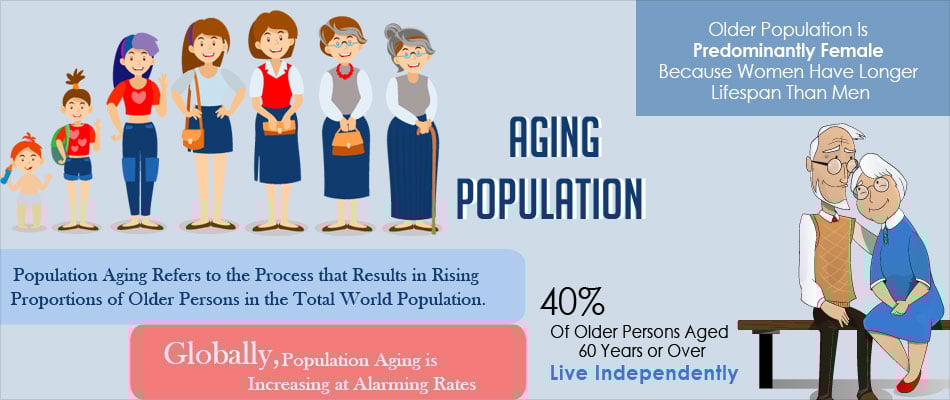
In 2017, for the first time in history, the number of people older than 64 years surpassed the number of children under 5 years old.
7. What is the average age of half of the world’s population today?
The average age of half of the world’s population today is below 30 years.
8. What proportion of the world’s population lives in urban areas today, and what is the expected proportion by 2050?
Today, 55% of the world’s population lives in urban areas, and this proportion is expected to increase to 68% by 2050.
9. What percentage of the world’s population lives in Asia?
As of 2022, Asia holds 60% of the world’s population, amounting to around 4.75 billion people.
10. What percentage of the world population do China and India each account for?
China and India each have almost 2.85 billion people, accounting for approximately 17.72% and 17.76% of the global population, respectively(18✔).
11. Which countries constitute contribute to half of the world’s population?
China, India, USA, Indonesia, Brazil, and Pakistan constitute half of the world’s population, with more than 1 in 3 people being either Chinese or Indian.
12. Which countries are projected to overtake China?
India overtook China in 2023. Nigeria could overtake India as the second most populous country by the end of the century, according to a UN study.
13. What percentage of the world’s population does the USA represent?
United States of America or USA represents 4.23% of the total world population (2023). The population of USA was 341,839,394 in July 2024 and it ranks number 3 in the list of countries by population(19✔).
14. What percentage of the world’s population does the UK represent?
The entire population of the UK, which is 6.7 million, accounts for only 0.88 percent of the world’s population.
15. What is the fertility rate of US population?
In 2024 the fertility rate is 1.786 births per woman
16. Which places have the lowest population in the world?
Vatican City, Rome (800) and Nauru Island in Central Pacific (9,378) are places with the lowest population.
17. How many international migrants were there in 2020?
In 2020, there were around 281 million international migrants, making up 3.6% of the global population.
18. Which country has the world’s youngest population, and what is the median age?
Niger has the world’s youngest population, with a median age of 15.1 years.
19. What was the average life expectancy in 1900 compared to 2024?
In 1900, the average life expectancy was 32 years, which more than doubled to 73.3 years by 2024.
20. What is the world’s total fertility rate in 2024?
The world’s total fertility rate has been declining rapidly. In 2024 it stands at 2.09. The total fertility rate was 2.4 births per woman in 2020 and has declined in the last four years.
21. Which countries are experiencing population decline?
Almost 20 countries are showing the largest percentage population decline and these include Bulgaria, Lithuania, Latvia, Ukraine, Serbia, Bosnia and Herzegovina, Croatia, Moldova, Japan, Albania, Romania, Greece, Estonia, Hungary, Poland, Georgia, Portugal, North Macedonia, Cuba and Italy(22✔).
22. Which country has the highest and lowest fertility rate?
In 2024 Niger had the highest fertility rate of 6.61 and South Korea had the lowest fertility rate of only 0.68.
In high-income and upper-middle-income countries, the total fertility rate has been below replacement level for a few decades(20✔,21✔).
World Fertility Rate
Year
World Fertility Rate in percentage
1950
5
1980
3.7
2000
2.7
2020
2.4
2024
2.03
U.S. Census Bureau - (https://www.commerce.gov/bureaus-and-offices/census)
Death rate, crude (per 1,000 people) - (https://data.worldbank.org/indicator/SP.DYN.CDRT.IN)
World Population - Wikipedia - (https://en.wikipedia.org/wiki/World_population#cite_note-2)
World Population to Hit Milestone With Birth of 7 Billionth Person - (https://www.pbs.org/newshour/show/world-population-to-hit-milestone-with-birth-of-7-billionth-person)
China + India: The Power of Two - (https://hbr.org/2007/12/china-india-the-power-of-two)
Population - (https://www.un.org/en/desa/world-population-reach-8-billion-15-november-2022)
World Population Day 11 July - (https://www.un.org/en/observances/world-population-day/background)
World population - Wikipedia - (https://en.wikipedia.org/wiki/World_population)
How Many People Have Ever Lived on Earth? - (https://www.prb.org/howmanypeoplehaveeverlivedonearth/)
Population and Migration - (http://www.oecd.org/sdd/01_Population_and_migration.pdf)
Which 7 countries hold half the world's population? - (https://www.pewresearch.org/fact-tank/2018/07/11/world-population-day/)
World Population Prospects 2019: Highlights - (https://www.un.org/development/desa/publications/world-population-prospects-2019-highlights.html)
World's Population is Projected to Nearly Stop Growing by the end of the Century - (https://www.pewresearch.org/fact-tank/2019/06/17/worlds-population-is-projected-to-nearly-stop-growing-by-the-end-of-the-century/)
Major Trends in Population Growth Around the World - (https://www.ncbi.nlm.nih.gov/pmc/articles/PMC8393076/)
World Population Prospects - (https://population.un.org/wpp/)
How Many People Have Ever Lived on Earth? - (https://www.prb.org/articles/how-many-people-have-ever-lived-on-earth/)
World Population Day - (https://www.un.org/en/observances/world-population-day/background)
India Population - (https://www.worldometers.info/world-population/india-population)
United States Population - (https://www.worldometers.info/world-population/us-population/)
Global fertility in 204 countries and territories, 1950�2021, with forecasts to 2100: - (https://www.thelancet.com/journals/lancet/article/PIIS0140-6736(24)00550-6/fulltext)
Total fertility rate - (https://en.wikipedia.org/wiki/Total_fertility_rate)
Countries with Declining Population 2024 - (https://worldpopulationreview.com/country-rankings/countries-with-declining-population)
Post a Comment
Comments should be on the topic and should not be abusive. The editorial team reserves the right to review and moderate the comments posted on the site.
Comments
anne-bartlett - May 06, 2024
The solution has always been in effect, just like the cause
Stupid extremes do not help
 MEDINDIA
 English
 हिन्दी
 Español
 français
 中文
中文
 Email
Email











The solution has always been in effect, just like the cause Stupid extremes do not help